An Early Signal Is Only the Beginning
Yes, AI can help detect certain health problems before symptoms appear, when it performs a defined screening task in the population for which it was evaluated. That is a narrower achievement than predicting every illness from a wearable or conversation. A retinal screening system may identify an eye finding that a person has not noticed; a risk model may instead estimate the chance of a future event. Neither makes the next decision disappear. The useful distinction is between a signal, the explanation it may support, and the assessment or care that follows. Understanding those steps helps you recognize a meaningful early-detection claim without treating every alert as a diagnosis or every normal result as a guarantee.
A: No. A meaningful assessment has a defined target, population, input, and evaluated scope. Broad wellness wording should not be interpreted as evidence that the service can identify every condition before symptoms develop.
A: No. A prediction estimates a specified future outcome over a period, while diagnosis concerns a current condition. Discuss the meaning and appropriate response rather than treating a risk score as confirmation of disease.
A: Tests can produce false positives. Their share among positive results depends partly on how common the condition is in the tested population, so a positive screen often needs confirmatory assessment rather than immediate diagnostic certainty.
A: No. Benefit depends on what is found, whether useful intervention follows, and the harms of testing or treatment. Earlier detection can increase measured survival or find harmless abnormalities without extending life or improving wellbeing.
A: It indicates that the image did not support a usable assessment under the system's requirements. It is not equivalent to a normal result. Follow the relevant instructions for obtaining an appropriate assessment or discussing the finding.
A: No. A general wearable score does not answer every screening question or replace an individualized preventive plan. Continue appropriate care and clarify the specific scope of any medical feature rather than relying on broad reassurance.
A: Discuss the finding with an appropriate clinician before changing prescribed treatment. The alert may need confirmation or contextual interpretation, and its intended use may not support medication decisions at all.
A: External validation and prospective evaluation in intended settings help establish performance beyond development data. Also examine the relevant population, inputs, version, workflow, and outcomes; one favorable result does not establish every form of real-world benefit.
A: An early signal needs an appropriate route to interpretation, confirmation, and care. Check who reviews findings, whether assessment is accessible, and what costs or delays may follow before assuming detection alone supplies practical benefit.
A: Seek appropriate urgent care based on the symptoms rather than waiting for a device alert. The service may assess only a narrow condition, miss a case, or lack a usable measurement; silence does not establish that urgent illness is absent.
Detection, Prediction, and Screening Answer Different Questions
Yes, selected systems can identify findings or estimate risk before a person notices symptoms. That answer applies to a defined task and tested population; it does not mean a general assistant can scan for every hidden illness. Consider two different questions: “Does this screening image contain a suspicious finding?” concerns something potentially present now. “Who is more likely to develop this outcome within five years?” concerns future probability. The first still needs confirmation and a care pathway; the second needs an effective response to the estimated risk. A useful early signal must improve a decision, not merely arrive before a symptom.
Detection asks whether evidence of a condition is present now. Prediction estimates the likelihood of an event or condition over a stated period. Screening applies a test or process to people without the relevant symptoms to identify those who may need further evaluation. AI can contribute to each task, but the output has to be interpreted according to the task the system was built to perform.
Consider the difference between an algorithm examining a retinal image for signs of diabetic eye disease and a model estimating a person’s future diabetes risk. The image assessment concerns visible findings in a particular organ. The risk model combines predictors to estimate a future probability. Neither output automatically establishes every aspect of the person’s current health, and the follow-up required is different.
Marketing language can blur these distinctions by calling every result an early warning. Look instead for the condition, the source of information, the intended population, and the time horizon. A claim that omits these details is hard to evaluate. Before asking whether AI is accurate, establish exactly what it is claiming to know.
A personal baseline is useful context, but it is not an explanation by itself. Knowing that a measurement differs from your usual value does not establish which cause produced the change. A system needs evidence linking the pattern to its claimed target and instructions about what to do when that evidence is insufficient. Personalization cannot remove the need for validation merely because a result looks specific to you.
Symptoms Can Lag Behind Measurable Changes
Some health problems develop gradually or remain unnoticed until testing reveals a change. Traditional screening already operates on that principle; AI did not invent the possibility of finding disease in an asymptomatic person. For example, clinicians use blood tests to diagnose diabetes and prediabetes, including in people whose risk factors justify testing before symptoms develop. The NIDDK explanation of diabetes testing describes this distinction between symptoms, risk, and diagnosis.
An algorithm may help identify whom to invite for assessment or interpret a particular kind of data, but it does not make ordinary measurement obsolete. A person can need a validated laboratory test even when a wearable looks reassuring. Conversely, a model can estimate elevated future risk while current diagnostic tests remain below a disease threshold. These findings address different questions rather than necessarily contradicting one another.
Clinical Imaging Shows Why Intended Use Matters
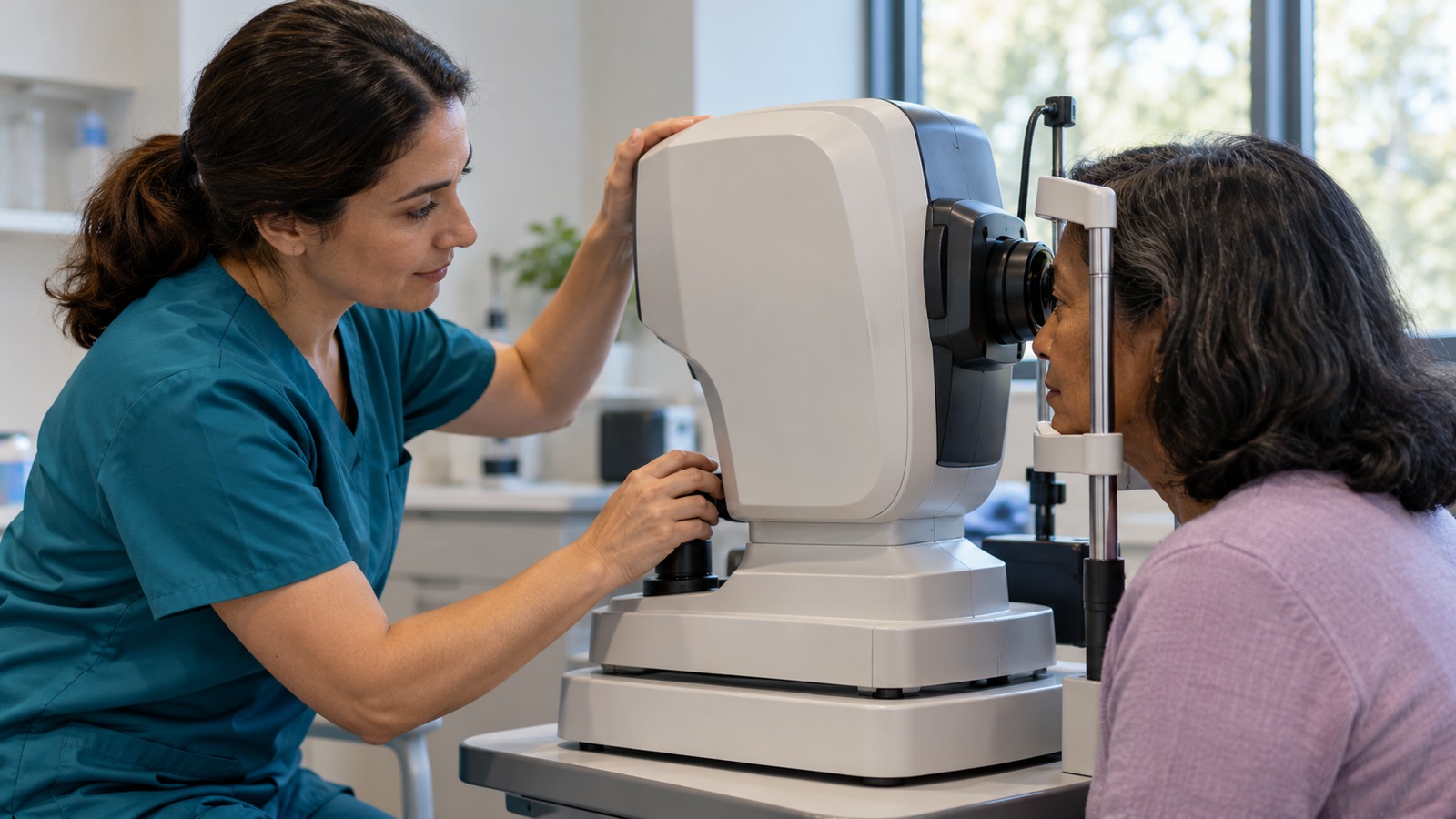
A concrete example is IDx-DR, described in FDA De Novo record DEN180001 and its 2018 pivotal study. Its defined task was autonomous detection of more than mild diabetic retinopathy in adults aged 22 or older with diabetes and no previous diagnosis of diabetic retinopathy. It uses specified retinal imaging, not an ordinary selfie. The example shows how an asymptomatic person can enter a useful screening pathway while the population, image requirements, and handling of unreadable results remain essential. It does not establish general-purpose detection of hidden disease.
A Wearable Alert Has a Different Kind of Context
Wearables can collect repeated signals during ordinary life, which makes them attractive for noticing changes that a brief appointment might miss. Repetition also creates many opportunities for incomplete readings, movement artifacts, and variation associated with travel, exercise, medication, or illness. A change relative to your usual pattern is information about a signal. It is not automatically evidence of a specific disease.
Some consumer ecosystems include narrowly defined medical notification functions alongside general wellness estimates. Apple’s sleep-apnea notification documentation is one example of why the distinction matters: use depends on eligibility and compatible equipment, and the absence of a notification does not establish the absence of the condition. Review the instructions for the particular notification, rather than generalizing from the brand or from a reassuring dashboard. Persistent symptoms still deserve appropriate evaluation.
Why an Apparently Accurate Test Can Produce Many False Alarms
Imagine a hypothetical screening program involving 1,000 people, of whom 10 actually have the target condition. Suppose its test detects nine of those cases but also flags about 50 of the 990 people without the condition. Roughly 59 people receive a positive result, yet only nine of them have the condition. These invented numbers illustrate how a relatively uncommon condition can make false positives a large share of positive results. They are not performance figures for any product.
Sensitivity describes how often the test identifies people who have the condition. Specificity describes how often it correctly classifies people without it. The probability that a positive result represents a true case also depends on how common the condition is in the tested population. A striking accuracy percentage without these details can conceal what a positive result will mean to an individual.
This is why broad screening of low-risk populations requires careful justification. Follow-up can involve appointments, additional tests, expense, anxiety, and sometimes invasive procedures. A screening program needs to show that these burdens are justified by the problems it finds and the outcomes it improves. Detecting more abnormalities is not, by itself, proof that people are better off.
Earlier Knowledge Helps Only When Something Useful Follows
Finding a problem sooner can create an opportunity for effective treatment, monitoring, or risk reduction. But the value depends on the condition and available intervention. Some findings would never have caused harm during a person’s lifetime, while others progress in ways that available treatment cannot meaningfully alter. These possibilities need to be considered when evaluating a claim of benefit from earlier detection.
Study design matters here. Measuring survival from the date of diagnosis can make earlier diagnosis appear beneficial simply because the clock starts sooner. Stronger evidence examines outcomes that avoid that trap, such as reductions in serious disease consequences or mortality in appropriately designed comparisons. Ask whether the study followed patients through care or merely showed that a model recognized a signal earlier in stored data.
Research Performance Must Survive Everyday Use
A retrospective study starts with information that already exists. It can reveal a promising association, but the research dataset may be cleaner or more complete than the information available during routine care. A model can also accidentally learn clues that would not be present at the actual moment of prediction. Prospective testing helps establish how the system behaves when people use it in the intended setting.
Look for external validation in patients and sites beyond those used to develop the model. Equipment, care access, documentation practices, and disease prevalence can all differ. A useful report explains who was included, how missing data were handled, and whether performance varied across relevant groups. An overall average can hide weaknesses that matter to a particular patient.
The workflow needs evaluation too. Does a positive result reach someone who can act? Can the service handle an unreadable image without labeling it normal? Are follow-up appointments available? An accurate algorithm attached to an unreliable response process can still fail the people it is supposed to help.
Also distinguish a technical improvement from a better patient experience. A model that flags a scan sooner may shorten one part of the process while leaving referral delays unchanged. Another may identify more borderline findings and create additional visits without changing treatment. Follow the result through the entire pathway, including uncertainty, time, and access, before deciding that an earlier timestamp represents a meaningful improvement in care.
Respond to an Alert Without Turning It Into a Diagnosis
Ask whether a recommended repeat measurement is intended to address poor signal quality or to investigate a clinical finding. Those are different purposes. Repeating a low-quality reading according to instructions may be reasonable, whereas repeatedly collecting reassuring readings to avoid an indicated assessment can delay care. If the instructions are ambiguous, request clarification from the responsible service rather than improvising a testing routine from the notification alone.
Start by identifying the source and purpose of the result. Save the date, wording, relevant measurements, and any instructions provided by the service. Check whether the system is reporting a trend, an estimated risk, an unreadable measurement, or a screening finding. These categories can be confused when a notification compresses them into a few alarming words.
Follow the product’s appropriate follow-up instructions and contact a qualified clinician when assessment is indicated. Do not change prescribed medication because an app suggests a risk, and do not keep repeating consumer tests in place of evaluation. If severe or urgent symptoms occur, act on the symptoms through appropriate urgent care rather than waiting for a device to confirm them. A saved output can support a conversation, but it should not dictate the conclusion before the underlying information is reviewed.
Normal Results Have Boundaries Too
A negative result means only what the particular test can support under its stated conditions. It may reduce concern about one target finding while saying nothing about other conditions, future changes, or periods with inadequate data. False negatives are also possible. Ask how the service handles signal quality and whether the result actually covers the question you care about. Routine preventive care should not disappear because a consumer interface offers an overall green score.
Judge the Whole Path From Signal to Outcome
Finally, consider whether the claimed finding would change an action you are prepared and able to take. A costly estimate without accessible follow-up may offer less value than completing a recommended preventive appointment. This is not a reason to dismiss emerging tools; it is a way to judge their practical contribution. Ask for evidence and a usable response pathway together, especially when the product is marketed to healthy people who may otherwise have little reason to suspect the condition.
Before paying for early-detection technology, trace a complete example: what enters the system, what finding it can produce, how that finding was validated, and what happens after a positive result. Check whether you belong to the population for which it was evaluated. Identify the organization responsible for follow-up and the likely costs beyond the initial scan or membership.
AI can help uncover certain problems before symptoms appear, especially when it performs a defined task within a reliable clinical process. Its value becomes clearer when the claim is narrow enough to test and the response is useful enough to justify screening. Keep that standard in mind when comparing an authorized clinical function, an emerging research model, and a general wellness prediction. They can all produce an impressive alert while offering very different levels of evidence and practical benefit.