Personalization Is Changing When, Where, and How Medical Decisions Are Made
Personalized health algorithms are moving medicine away from decisions based only on broad averages and toward care that responds to the patient’s own pattern. Their influence is visible across prevention, diagnosis, treatment selection, hospital operations, and recovery at home. A model may identify who needs earlier screening, help a radiologist prioritize a concerning scan, estimate which therapy is more likely to help, or detect that a person’s recovery is drifting off course. The transformation is not simply that computers can process more data. It is that well-designed systems can place relevant evidence into the clinical workflow at a moment when a patient and care team can act on it. That promise comes with obligations: prove benefit, control bias, protect privacy, and preserve professional and patient judgment.
A: No. They usually refine how population evidence applies to a particular patient and decision.
A: Risk can be estimated before symptoms become severe, creating an opportunity for targeted screening or support.
A: No. Monitoring should be reserved for situations where new data can lead to a useful response.
A: It may reduce avoidable complications or low-value services, but implementation and false alarms can also add costs.
A: Individualized estimates can make tradeoffs clearer, while the patient still determines which outcomes and burdens matter most.
A: It is the tendency to give an automated suggestion more authority than its evidence or context deserves.
A: Patient populations, equipment, documentation, and workflows differ enough to change real performance.
A: Possibly, but transportability must be demonstrated rather than assumed.
A: They often interpret alerts, coordinate follow-up, manage medications, and shape whether a prediction leads to better care.
A: Measurable benefit, equitable performance, protected data, understandable outputs, and clear human accountability.
From Population Averages to Patient-Specific Decisions
Modern medicine depends on population evidence. Clinical trials and public-health studies reveal which interventions generally help, which risks deserve attention, and which practices cause harm. The limitation is that an average effect may not describe every individual. Two patients with the same diagnosis can differ in age, other conditions, genetics, medication use, daily environment, and goals. Personalized algorithms add a layer that estimates how those differences may change the meaning of general evidence for a particular case.
This shift is especially valuable when choices involve tradeoffs. A treatment that offers a modest average benefit may be worthwhile for a patient at high risk of complications but unnecessary for someone at low risk. A screening schedule designed for the general population may be too late for a person with strong family history or too frequent for another person with limited expected benefit. Algorithms can organize these factors consistently, allowing conversations to focus on likely outcomes rather than relying only on a one-size-fits-all category.
The goal is not to abandon guidelines. Instead, personalization can make guidelines more precise by identifying where an individual sits within the range of patients represented by the evidence. The care team still must consider values, feasibility, and information the model does not know. Transformation occurs when the algorithm improves the question a clinician and patient are able to ask: not merely “What usually works?” but “Given this person’s circumstances, which reasonable choice is most likely to help?”
Earlier Prevention and More Targeted Screening
Preventive medicine has traditionally relied on age bands, periodic appointments, and a limited set of risk factors. Personalized models can evaluate a wider pattern and update estimates as new information appears. Changes in blood pressure, laboratory results, family history, medications, or home monitoring may move a patient into a group that benefits from earlier attention. A care organization can also use risk stratification to find people who have quietly fallen behind on screening or whose records suggest a need for outreach.
Targeting matters because healthcare capacity is limited. Sending every patient for every possible test creates cost, anxiety, false positives, and unnecessary procedures. A useful algorithm helps direct resources toward people with a plausible opportunity for benefit. It should also make the consequences of mistakes visible. Missing a high-risk person and over-testing a low-risk person are different harms, and the acceptable balance varies by disease, test, and available follow-up care.
Diagnosis Becomes a Coordinated Interpretation of Many Signals
Diagnostic work increasingly involves data that no single professional can examine continuously. Images, pathology, laboratory trends, bedside measurements, notes, medication records, and patient-reported symptoms may each contain part of the story. Personalized algorithms can connect those sources and highlight combinations associated with a condition or deterioration. In imaging, for instance, a model may identify regions that deserve closer review while also considering prior scans or clinical history.
The best diagnostic support strengthens attention rather than replacing it. It can prioritize urgent cases, quantify subtle change, or remind the reader of a plausible alternative. Clinicians then inspect the original evidence and decide whether the finding fits. This partnership can reduce delays and variability, but only when the tool is evaluated against the real workflow. A model that performs well on a curated dataset may struggle with different equipment, incomplete records, uncommon disease, or patients who have several conditions at once.
Personalization can also improve diagnostic timing. Instead of waiting for one measurement to become clearly abnormal, a system may recognize a gradual departure from a patient’s baseline. That can prompt an earlier conversation or confirmatory test. Early detection is useful only if there is a sensible next step, however. Flagging a problem without access to evaluation or treatment can increase distress and widen inequities between people who can obtain follow-up and those who cannot.
Treatment Selection and Dosing Become More Adaptive
Treatment decisions often begin with evidence about what worked for groups of patients. Personalized models can estimate differences in response and side-effect risk using clinical characteristics, biomarkers, prior therapies, and sometimes genomic information. Oncology offers familiar examples, with tumor features helping determine whether a targeted drug is likely to work. Similar approaches are developing in cardiology, psychiatry, infectious disease, and chronic-condition management.
Care Can Continue Beyond the Clinic
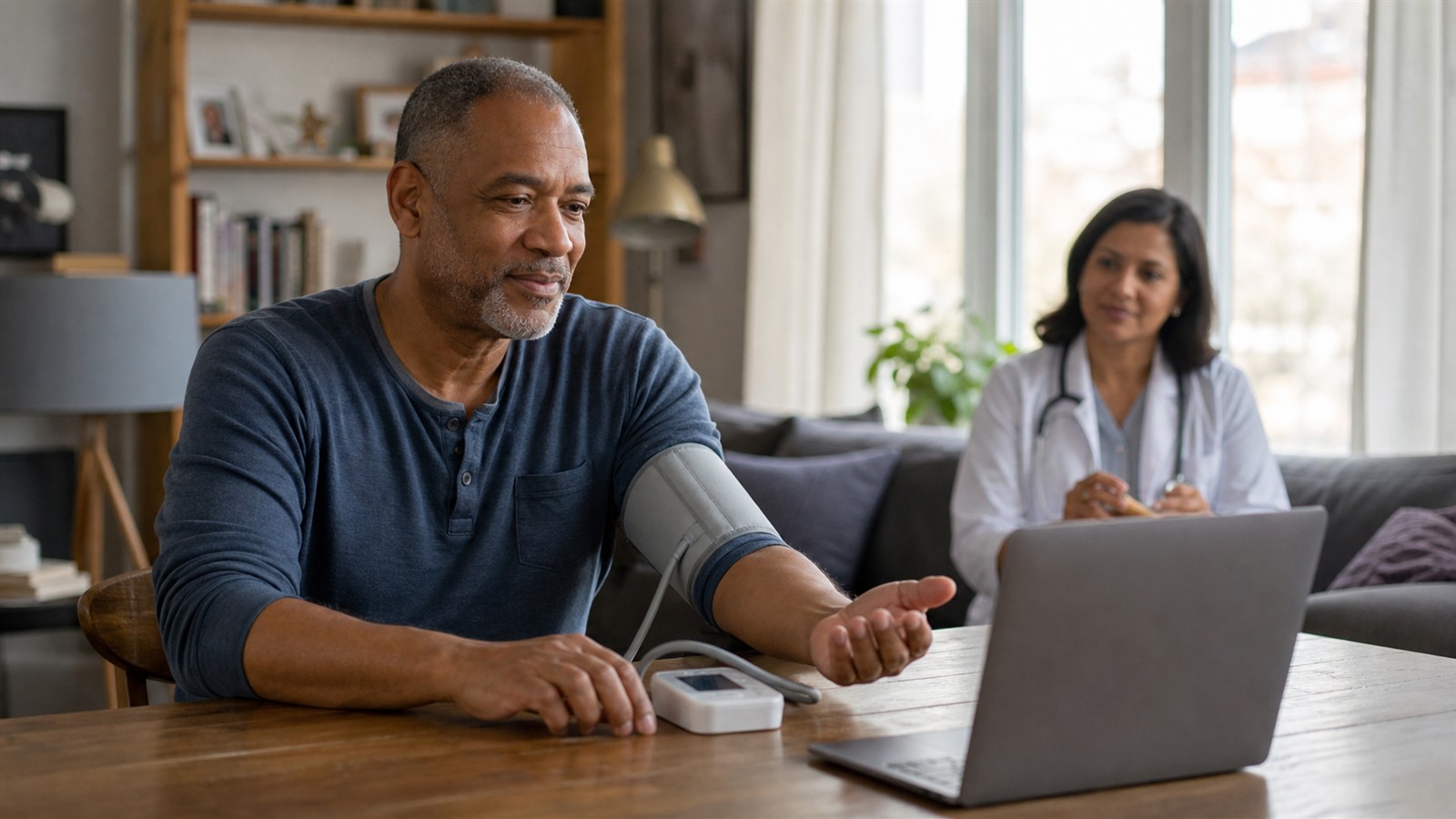
Remote monitoring extends personalization into daily life. Home blood-pressure readings, glucose measurements, symptom reports, activity patterns, and connected-device data can show whether a plan is working between appointments. An algorithm may look for sustained change rather than reacting to every fluctuation. It can adjust education, suggest a routine check-in, or escalate a concerning pattern to the care team. This turns follow-up from a fixed calendar into a process that can respond to need.
The transformation is operational as well as clinical. Nurses and care managers cannot review every incoming measurement manually. Thoughtful prioritization helps them focus on patients most likely to need assistance. Poorly tuned systems do the opposite by creating excessive alerts and fragmented tasks. Successful programs define who receives each signal, how quickly they should respond, what information they need, and how the patient can reach a person when the technology does not reflect what they are experiencing.
Clinical Workflows and Professional Roles Are Changing
Personalized algorithms create new forms of work. Clinicians need to interpret probabilities, recognize when a model does not apply, and explain an automated recommendation in understandable language. Data professionals must maintain pipelines, monitor performance, and investigate changes. Health-system leaders must decide which tools solve a genuine problem rather than adding another dashboard. Patients increasingly need clear information about how their data contributes to a recommendation and how much influence the system had.
These changes favor multidisciplinary teams. A technically impressive model can fail if it ignores how appointments, documentation, referrals, and follow-up actually happen. Conversely, a modest model that answers a focused question at the right moment may have substantial value. Designers must work with clinicians, patients, privacy specialists, informaticians, and operations staff from the beginning. Their job is to shape both the prediction and the pathway around it.
Professional judgment remains essential because medicine contains exceptions, competing goals, and moral choices. An algorithm may estimate survival, readmission, or treatment response, but it cannot determine what outcome a patient values most. It may not know that transportation is unavailable, caregiving duties limit a treatment schedule, or a previous experience makes a recommendation unacceptable. Modern medicine is transformed most constructively when computational consistency and human context reinforce one another.
Evidence, Equity, and Privacy Determine Whether Change Is Progress
A personalized system should be judged by patient outcomes and workflow consequences, not only by statistical accuracy. Evaluation may examine whether the tool reduces complications, shortens time to treatment, improves quality of life, or uses resources more appropriately. It should also measure burdens such as false alarms, extra testing, clinician time, and patient anxiety. Comparisons with existing practice are crucial because a model can look accurate in isolation while adding little value to the decisions people already make.
Equity analysis asks who benefits and who carries the errors. Historical records reflect unequal access, inconsistent documentation, and prior discrimination. Models can transform those patterns into seemingly objective scores unless teams inspect subgroup performance and the meaning of each variable. Privacy protections must evolve as systems combine data from clinics, laboratories, devices, and consumer services. Patients deserve understandable choices and limits, particularly when information may be reused beyond their immediate care.
The Next Phase Will Focus on Learning Health Systems
The most consequential change may be the growth of health systems that learn from routine care. Outcomes can show whether recommendations helped, which patients were missed, and where workflows broke down. A prevention program may discover that its risk estimates are sound but that high-risk patients cannot obtain the recommended appointments. A hospital may find that an alert arrives at the right time but lacks the evidence a clinician needs to act confidently. Learning therefore includes the service surrounding the model, not just the mathematics inside it. That feedback can guide careful improvement rather than leaving a model unchanged for years. Continuous learning does not mean uncontrolled self-modification. Updates require versioning, validation, oversight, and a way to trace which model influenced a decision. Organizations need thresholds for when performance change triggers investigation, when a model should be paused, and when users must be notified. They also need to protect against a feedback loop in which earlier model decisions shape later training data and gradually reinforce the system’s own assumptions. Future personalization is likely to combine more kinds of evidence. Imaging, laboratory trends, clinical language, genomics, and home measurements may contribute to one coordinated estimate. Multimodal systems could reduce the fragmentation that forces professionals to assemble a case manually. Yet combining sources can make errors harder to trace and increase the consequences of missing data. Explanations should show not only which factors influenced a result but also which expected sources were unavailable and how that absence affected confidence. Payment and regulation will shape adoption as much as technical capability. Care organizations need incentives to invest in prevention and follow-up, not merely to purchase software. Regulators and professional bodies will continue clarifying evidence, change control, and accountability for adaptive systems. Procurement teams will need access to validation results and contractual rights to monitor performance. Patients will need accessible ways to understand and challenge automated influence. That includes knowing when a recommendation came from an algorithm, obtaining a plain-language explanation, correcting inaccurate records, and requesting human review. Health systems should measure whether these options are genuinely usable rather than merely available in policy. Community participation can reveal concerns that technical teams miss, particularly where historical misuse of health information has damaged trust. Education will matter across the workforce. Clinicians do not need to become machine-learning engineers, but they do need enough statistical and practical literacy to recognize uncertainty, drift, and inappropriate use. Technical teams need exposure to clinical workflow and patient safety. Leaders need to understand that implementation includes staffing, training, support, and evaluation after purchase. These shared capabilities will determine whether personalization becomes routine improvement or a collection of disconnected experiments. As personalized algorithms mature, the winners will not be the systems with the largest number of predictions. They will be the ones that turn individual data into timely, fair, explainable action while earning the trust of the people whose care is affected.